Chalk House Elemenary Version
(May 2011)
CRG has started working on the elementary grade level of Chalk House. From presentations and conferences over the past year, one of the most frequently asked questions has been "Is there an elementary version?". Plans are to have the elemenary version available for testing in the future.
E-mail crg@created-realities.com to request information and the application to be part of the testing of this version.
Chalk House Spring 2011 Research Trial
(Januray 2011)
The Spring 2011 research trials ended very successfully. Thanks to those that particpated. With a sample of over 200 middle school students the results are showing very positive outcomes to impact on reading and comprehension over the 25 hours of materials. We will be working on a journal article in the coming year or so that discusses the research findings from the last several trials.
Chalk House Version 6 RC2 Released
(January 2011)
Chalk House version 6 RC2 has been released. It contains a number of improvements over the previous version including new animations, improved lightening, help system, and the ablity for students to download feedback sent back to them from the "Editor in Chief". Version 6 RC3 is under development and should be out sometime this summer with additional improvements based off teacher and student feedback.
Chalk House Spring 2010 Research Trial
(Januray 2010)
The Spring Trials ended very successfully. Thanks to those that particpated. The research has helped further improve the questing tree and helped us better understand the nature of reading length and age in the environment.
The spring 2010 research trial will happen between January 15 and June 1, 2010. We are looking for schools and teachers that can use the software for about 10-15 hours of use during the spring.
Chalk House Fall 2009 Research Trial
(August 2009)
Thanks to everyone that particpate in the Fall 2009 research trial. The results indicate that reading level and comprehension is increased. How much we are still working on and the answer will require additional research in the upcoming trials.
The fall 2009 research trial will happen between September 15 and December 20, 2009. We are looking for schools and teachers that can use the software for about 10-15 hours of use during the fall. The deadline for application is August 30, 2009.
 
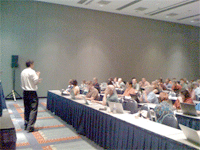
Chalk House at NECC 2009
(July 2009)
CRG launched Chalk House during the
2009 National Educational
Computing Conference in Washington, DC at the Games and Simulations Playground. While the live demo in the BYOL session had some network glitches that slowed the demo down considerably, we had a lot of interest in Chalk House. The demo shown at the BYOL session is now available. CRG will be sending out the research/testing particpation information before the end of July. Thanks to all those that came by and visited and took a look at Chalk House.
Chalk House Update June
(June 2009)
RC1 was released to testers. We were all pretty happy to see RC1 go out for testing. We expect to fix bugs and do updates over the summer, preparing for release of the first production version into school during the fall of 2009. We have a list of teachers interested in providing feedback, but are always looking for more teachers and schools interested in particiapting in research of the learning module.
Virtual Center of Excellence Workshop
(May 2009)
Created Realities Group presented at the Virtual Center of Excellence Workshop held at NASA Langley Research Center. The purpose of the workshop was to define requirements for a Virtual Center of Excellence for Education, Research, and Training. We presented on current research and development and provided the workshop with some thoughts on the need for a framework to support community. See Presentation.
Chalk House Update March
(March 2009)
We are finishing up the last internal revisions before having additional teachers and students use test the software. We have a list of teachers interested in providing feedback, but are always looking for more teachers and schools interested in particiapting in research of the learning module.
Chalk House Update January
(January 2009)
Chalk House is in final testing and plans are to have additional teacher and student testing in March and April of this year.
The main purposes of Chalk House is four-fold: it 1) prepare students for inquiry-related experiences by targeting improvements in organizational and learning skills such as note taking, peer review, and collaboration; 2) improve student descriptive report writing by providing expert feedback while making it part game play; 3) increase student reading recall, comprehension, and vocabulary by providing motivating reasons to read and game-related uses for what they have learned and; 4) provide students with the opportunity to enhance critical thinking, problem solving, and inference skills through game play prior to engaging in other forms of inquiry.
For more information contact crg@created-realities.com
CRG End of the Year 2008 News
(December 2008)
A brief update as to status of projects. Chalk House continues in use testing. We will be pushing forward to completing testing and enter production in 2009. We look forward to that milestone.
We are looking forward to getting Chalk House into production and welcome schools interested in participating in our formal research efforts.
Texas Computer Education Association
(February 2008)
CRG was at the Texas Computer Education Association (TCEA) conference. We had a lot of folks come by and look at the Chalk House demo. We are looking forward to keeping in contact with everyone in the coming months. John Rice, who visited, just posted a nice overview of Chalk House on his blog Educational Games Research. Now that the conference is over, we are working towards getting Chalk House into production. Keep an eye on our web or our RSS Feed for news updates.
CRG Forums
(January 2008)
The CRG message board is back online and ready for use. If you have questions or problems, you can either send us e-mail directly at crg@created-realities.com or use the message board.
CRG End of the Year 2007 News
(December 2007)
Lots of news to end the year. Chalk House is in use testing, with two school districts scheduled to begin use in the spring of 2007. CRG will be showing Chalk House at the Texas Computer Education Association (TCEA) the first of February (booth 2319). The online demo of Chalk House will be available shortly after the TCEA convention. The CRG Distance Learning System (DLS) has been in stable use the past six months at two universities. While CRG is focused on Chalk House, we are continuing active development of the 3D online learning environment for future sales. We are looking forward to getting Chalk House into production and welcome schools interested in participating in our formal research efforts.
CRG RSS Feed
(November 2007)
The CRG RSS Feed  is now available to those who like to follow content changes, news, and reports. is now available to those who like to follow content changes, news, and reports.
Chalk House Update
(October 2007)
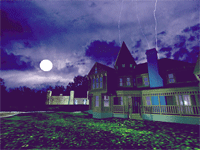
Chalk House is in testing and plans are to have limited classroom testing with students later this year. CRG and DRC are looking for teachers and schools interested in particiapting in research of the learning module during 2008.
The main purposes of Chalk House is four-fold: it 1) prepare students for inquiry-related experiences by targeting improvements in organizational and learning skills such as note taking, peer review, and collaboration; 2) improve student descriptive report writing by providing expert feedback while making it part game play; 3) increase student reading recall, comprehension, and vocabulary by providing motivating reasons to read and game-related uses for what they have learned and; 4) provide students with the opportunity to enhance critical thinking, problem solving, and inference skills through game play prior to engaging in other forms of inquiry.
For more information contact crg@created-realities.com
ChalkHouse Shown at NECC 2007

(June 2007)
Scott Warren and Greg Jones presented Chalk House for the first time to educators during the
2007 National Educational
Computing Conference in Atlanta. There was a lot of interest in the development and we hope that many of the teachers
and schools
that showed interest in the development will select to participate during the design and
research in the fall.
ChalkHouse Development Continues
(May 2007)
Development of Chalk House continues on schedule. Critical
Mass Interactive, a design firm in Austin, has joined the project to provide art and environments for the project.
CMI has been very supportive of CRG's work in the past few years. Thanks guys!
Chalk House, the first in a series of situated learning modules being developed as a collaboration between
Created Realities Group and the
Design+Research Collective, is an online computer-based 3D
environment in which game play and engaging narrative are used to improve student literacy skills. Chalk House uses the CRG 3D online
learning environment to deliver this learning module. Stay turned for more information as development continues.
For more information contact crg@created-realities.com
v5 Beta Testing
(March 2007)
The v5 Distributed Learning System has been released to Beta Testing. Testers in several locations are using the environment for
university course delivery. A production release is scheduled for later this year. For more information
contact crg@created-realities.com
The Global Challenge Award trials CRG as their 3D Online Learning Environment
(December 2006)
 The Global Challenge, recently funded by the
ITEST program of the National Science Foundation,
engages parents, teachers, students and the community in a high-impact educational experience that teaches
about complex systems and global engineering challenges while enhancing K12 education and strengthening the
pipeline of students entering science, technology, engineering and mathematics.
The Global Challenge, recently funded by the
ITEST program of the National Science Foundation,
engages parents, teachers, students and the community in a high-impact educational experience that teaches
about complex systems and global engineering challenges while enhancing K12 education and strengthening the
pipeline of students entering science, technology, engineering and mathematics.
The Global Challenge Award evaluated the CRG 3D Online Learning Environment during the spring of 2007 for presentations of their final projects.
3D online learning environment developed by CRG have been succesfully
integrating voice, collabortive tools, and 3D environments since 2002 to support formal learning.
Research is an important part of CRG's mission and this association will continue the research into use of the
latest in 3D technolgoies to support new ways and modes of learning and collaboration.
For more information contact crg@created-realities.com
 ChalkHouse Project Starts
(September 2006)
Chalk House, the first in a series of situated learning modules being developed as a collaboration between
Created Realities Group and the
Design+Research Collective, is an online computer-based 3D
environment in which game play and engaging narrative are used to improve student literacy skills,
namely reading and writing, are the key focus of learning. Chalk House uses the CRG 3D online
learning environment to deliver this learning module. Stay turned for more information as development continues.
For more information contact crg@created-realities.com
(July 2006)
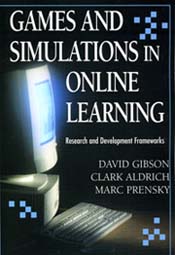 Dr. Greg Jones and Dr. Stephen Bronack, in Chapter 5 on Rethinking Cognition, Representations, and Process in 3D Online Social Learning Environments, discusses both how ActiveWorld's and CRG's systems are being used in college course delivery. Chapter 5 Abstract: Three-dimensional (3D) online social environments have emerged as viable alternatives to traditional methods of creating spaces for teachers and learners to teach to and to learn from one another. Robust environments with a bias toward peer-based, network-driven learning allow learners in formal environments to make meaning in ways more similar to those used in informal and in-person settings. These new created environments do so by accounting for presence, immediacy, movement, artifacts, and multi-modal communications in ways that help learners create their own paths of knowing using peer-supported methods. In this chapter, we will review the basics of the technologies and the theoretical underpinnings that support the development of such environments, provide a framework for creating, sustaining, and considering the effectiveness of such environments, and will conclude by describing two examples of 3D virtual worlds used to support course instruction at the university level.
TechEdge Article - "The (Virtual) Classroom of Tomorrow"
(July 2006)
John Rice, program/project coordinator with TCET, just published an article on 3D environments and their future in education. The article appears in the Texas Computer Education Association's (TCEA) TechEdge magazine (Volume 25, No. 3). The article discusses the CRG software along with ActiveWorlds and SecondLife. He talks about how online 3D environments could impact the future of distributed education.
( Article). Article).
Version 5 Prototype
(May 2006)
The version 5 prototype is operational. It has a ways to go before we will be ready to deploy as a finished distributed learning product. The prototype will be used during the summer to test the system before moving to a production release in the fall. It is our plan to release an evaluation version sometime after the production release for those interested to experiment with the system.
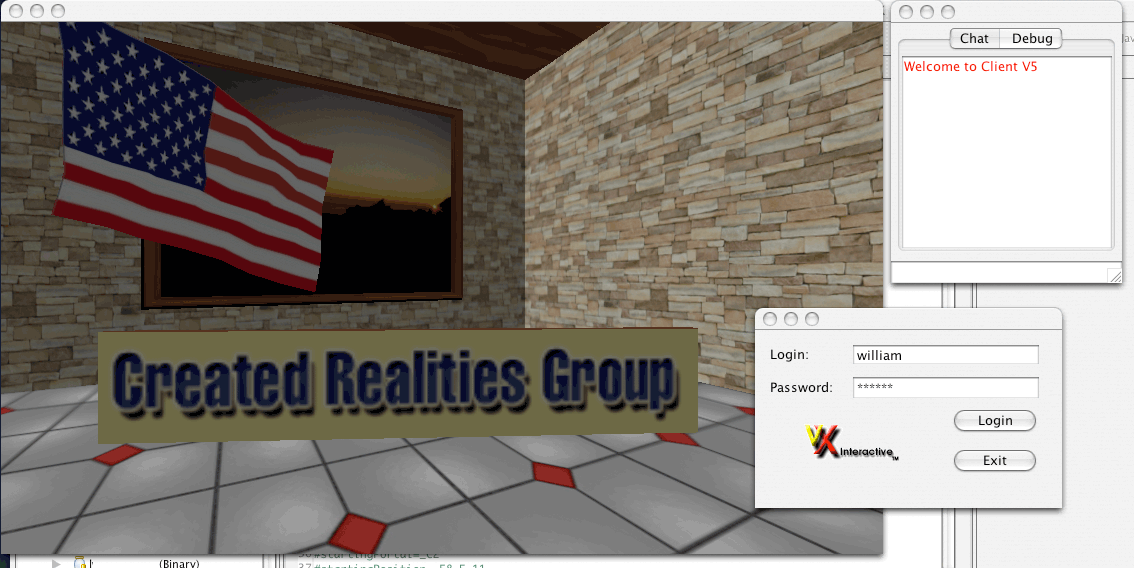
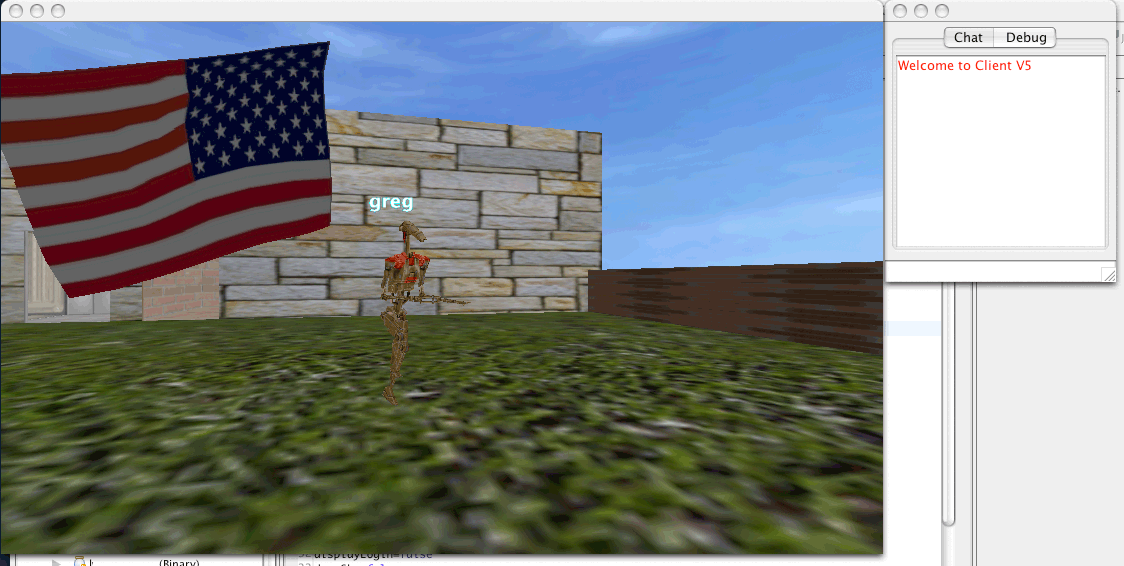
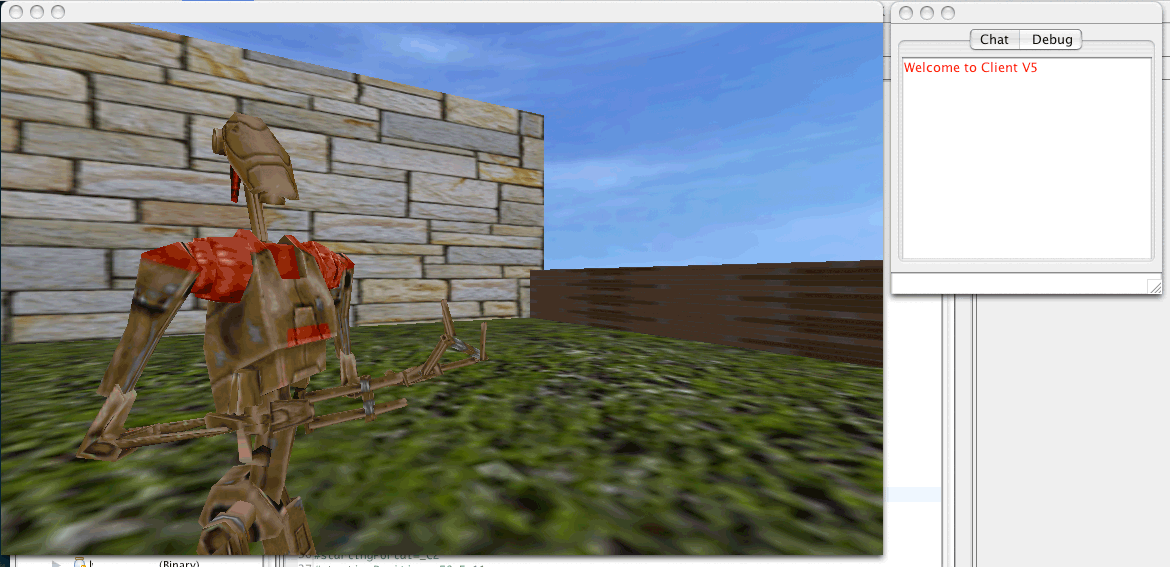
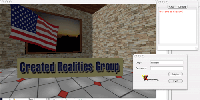
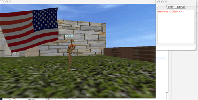
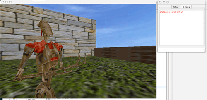
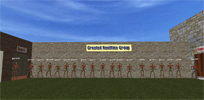
The new development is showing its potential and flexibility of the design set forth in 2005. We have been successful in integrating Swing/AWT into the 3D interface for both Windows and Mac platforms. This will provide tremendous flexibility in what 2D interface over the version 3 interface. The new pixel/vertex shader render, that has replaced the original code Jeramie Hicks developed, has greatly improved the graphic interface. The prototype does support some new features that include a shared interactive textboard, environment scripting, and more. Below are some screen shots form the prototype running on a Dual 2.5Ghz PowerPC G5, Max OS X 10.4.6. We will be working up an interactive presentation of the working system in the coming months.
Version 5 Development Underway
(January 2006)
After a slow year of development and continued research using the version 3 software in 2005, version 5 development is underway. Version 5 contains functionality deployed in version 3 plus with enhancements based from our research using the software in course delivery the past several years.
Version 4 Development Halts, Version 5 begins
February 2005
After much discussion, version 4 development has been stopped. The group felt that the development of version 4 was not going to meet the desired functional requirements. After a total functional review and continued discussion concerning long term product needs, version 5 development has begun. A totally new server and client will be developed based from our experiences achieved from the earlier versions being tested and used in online courses.
Version 3 end of life
June 2005
CRG has decided to begin to phase out version 3. CRG will continue to support those using the version 3 system, until version 5 is available. However, this decision means that CRG will no longer promote the use of version 3 into distributed learning environments. While version 3 has been successful in online learning situations it has been placed, we believe that version 5 will be a much more useful development with fewer problems that version 3 faces.
Version 4
October 2004
With the release of version 3, CRG has begun development of version 4. Version 4 continues to enhance core systems and adds additional features to support course delivery. Some of the enhancements include a sub-system handshake on client connection, conference organizer interface, and avatar selection interface.
Version 3 enters production
September 2004
The version 3 client/server has been released for production and is in use. The client is available for both MS Windows OS and Mac OSX. The system includes several new course related features. The newest feature is the whiteboard that sits on top of the slide show interface.
University of Hawaii
July 2004
The University of Hawaii is beta-testing the CRG software this summer for three courses that include Computers in Education and Educating Exceptional Students in Regular Classrooms. The students are participating in a survey related to attitudes towards technology. Results from this use will be reported in a future publication.
Mac Client
January 2004
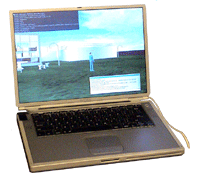
The mac version of the CRG client is now available. Users of a system can request the Mac install image from their system administrators. The client will run 100% under Mac OS X 10.3. If Mac OS X 10.2 has JavaVM 1.4.2 installed, then it will support the client. The issue is that Apple stopped releasing JavaVM 1.4.2 under the 10.2 software updater, so unless you had installed the JavaVM prior to that date, you will need to be running Mac OS X 10.3.
Mac Client Update
December 2003
The mac version of the client is making good progress. We are working out some design issues to handle having the client under Mac OSX. Mac OSX v10.2 is supported and we are working on issues required to support v10.3. Several CRG participants are using the alpha version of the client. We will be posting on the CRG list as soon as the client is available for beta-testing.
Version 2 Client and Server
September 2003
The new version 2 client and version 2 server are complete and have entered beta-testing. The new client is totally java-based, replacing the version 1 client which had been developed in C++. Windows OS is the first client release. Linux and Mac versions are under development. The version 2 server, which was originally developed in java, has been enhanced to allow future growth of the project.
National Educational Computing Conference (NECC)
July 2003
Dr. Jones presented a poster session at the National Educational Computing Conference (NECC) entitled "Using Next Generation 3-D Graphical MOOs for Internet-Based Distributed Learning". The session focused on the educational aspects of the CRG software and demos were given of the on-line virtual communication space for course delivery and the MARS environment. There was a lot of interest in the potential for 3D MOOs to be used in K-12 and college level applications. The paper can be found in the white paper section.
Japan Society for the Promotion of Science (JSPS) awards research grant concerning CRG software
May 2003
Dr. Akira Sakamoto of Ochanomizu University, Tokyo, Japan has received a research grant to study the effectiveness of using the CRG Distributed Learning System as a learning tool for students who are studying Japanese. The study will examine motivation and engagement using tested and appropriate instruments for students who are studying Japanese using an on-line virtual system and also examine the systems effectiveness in improving language acquisition. Dr. Sakamoto and his group will be working with the Institute for the International Exchange of Students (IES) who are using the CRG Distributed Learning System for having students make contact before exchanges occur.

University of North Texas awards grant to use CRG Software
March 2003
The University of North Texas Teaching with Technology Grant program has awarded Dr. Gerald Knezek funds to use the CRG distance learning system to deliver courses in computer education during the Fall of 2003 and Spring of 2004 semesters. This is the first such grant that supports using the CRG software and we would like to recognize Dr. Knezek's work. The grant entitled "Technology Integration Opportunities for Non-Traditional Students: A Virtual Classroom Environment for CECS 4100 (Computers in Education) Students" will use the CRG system to 1) reduce the number of in-class meetings required for these non-traditional students to approximately 40% by introducing a real-time interactive system that allows students to "meet" as a class for the remaining 9 sessions and 2) to show the potential of new technologies to enhance the student and instructor contact hours, without requiring students to have access to broadband Internet connections.
The Institute for the International Exchange of Students (IES) begins Pilot-Testing CRG Software
March 2003
The Institute for the International Exchange of Students (IES) has selected the CRG Distributed Learning System as a way to enhance interchange between participating students before their exchange trips. IES has been using e-mail between participating students up to this time and the pilot-test is looking at the potential of presence, text, and audio as a way to increase the personal connections made between students before exchanges.
Mars On-Line Project.
March 2003
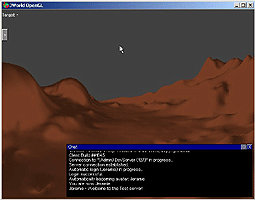
One of the first portals to be viewed using the MOLA data (sector 1,195 Nicholson Crater). The prototype system will eventually allow any part of mars to be loaded and explored real-time over the Internet using the CRG VXInteractive client. There will be over 64,000 portals (areas) to explore once the version 1 interface is fully operational. (Screen Captures)
Pilot testing continues at the University of North Texas
January 2003
The server code has been revised to correct the problems encountered during the Fall 2002 pilot testing.
3D context based speech recognition/natural language learning
January 2003
Development continues on the on-line 3D context based speech recognition/natural language learning. Dr. Greg Jones and Dr. Todd Squires, another visiting scholar at NIME, have developed a concept of using the VXInteractive™ collaborative environment for on-line natural language education. The goal of the research is to create an Internet-based Spoken Language learning system that should provide more interactive and motivating learning than current multimedia and audiotape-based systems. The concept is to combine the CRG software with current state-of-the-art speech recognition software to create an immersive contextually accurate space for language learning. The prototype is completed and shows basic functionality of using this type of process to interact with the system in a learning environment. With the change in status from the vendor to limit open development, this project faces termination.
University of North Texas Pilot Testing
December 2002
Distributed Learning System will be pilot tested with CECS 5400 Educational Telecommunications Spring 2003 course at the University of North Texas. It will provide discourse between remotely located classes.
New Version 2 Features
September 2002
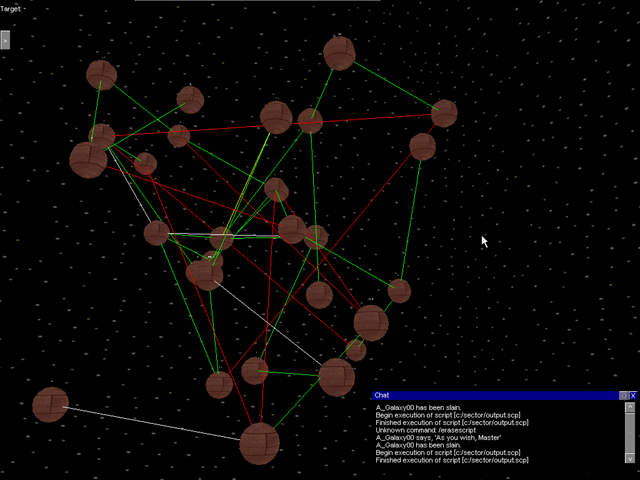
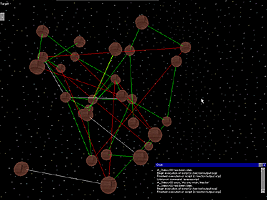
White Board, 3D data presentation portal, portal recording feature. These where scheduled for version 2, but our development schedule has allowed us to deploy them early. A VNC plugin that will allow the presentation of remote computer screens within the environment is under development.
Picture Right: New 3D data presentation portals. This data was plotted and displayed real-time. It shows data points that are connected by differing levels of connections (different colors). The information once plotted can be walked around. This allows the user better understanding of the data in a visual presentation.
National Institute of Multimedia in Education, Japan
March 2002
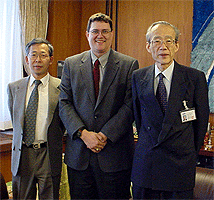
Dr. Greg Jones, seen here with his host Dr. Kimio KONDO, NIME Executive Director Research and Development Department, and Dr. Takashi SAKAMOTO, NIME Director General. Greg is in Japan on a three month sponsored research grant from the Japanese Society Promotion of Science (JSPS) conducting research at the National Institute of Multimedia in Education (NIME) which is located in Makuhari, just outside Tokyo. He is conducting research on 3D online learning environments and working with researchers on various technology issues.
Version 1 Alpha Released
January 2002
Alpha testing of the CRG VXInteractive client begins. First CRG production server goes on-line. Distributed Learning System development continues.

Created Realities Group
January 2001
CRG is formalized and begins working on the initial development of a distributed learning system based on the concepts and research begun by Dr. Jones in 1995. Jeramie Hicks joins CRG and we begin to develop version 1 of the VXI™ client.
|